Thursday, January 9, 2014

To Write Or Not To Write...

It seems most would agree that to make a reputation as an influential professional historian, one must write and publish not only books, but all sorts of printed matter for public consumption.  Yesterday, at the main museum I noticed a new book in our library, Lincoln and Whitman, by William E. Barton, Clara Barton's cousin.  Funny I thought, I was just looking through his biography of Miss Barton to find some outstanding quotes for part of the CBMSO's exhibits, and spoke to the museum's Director of Research about his peerless credibility as a Barton biographer.  The inside cover of Lincoln and Whitman is filled with several reviews by his peers outlining his expertise as a Lincoln scholar.

Part of my work at the museum is to develop material for all types of programming.  Naturally, my first thoughts centered on what to write and publish in regards to my research on Barton.  But a problem arises due to the amount of work already available to the public.  One may find so much varying material on Barton already that covers just about every aspect of her being as to give a fairly balanced perception of this legendary woman.  William Barton's biography and Stephen Oates' focus on the Civil War years (A Woman of Valor: Clara Barton and the Civil War), two favorites, leave almost no stone unturned.  While writing and designing programming material is still necessary to cover specific aspects the museum will highlight, the question still remains- what major work could be accomplished on Barton that will fascinate and inspire interested citizens as well as catch those who are blissfully unaware of the extraordinary importance of a long-gone heroine?
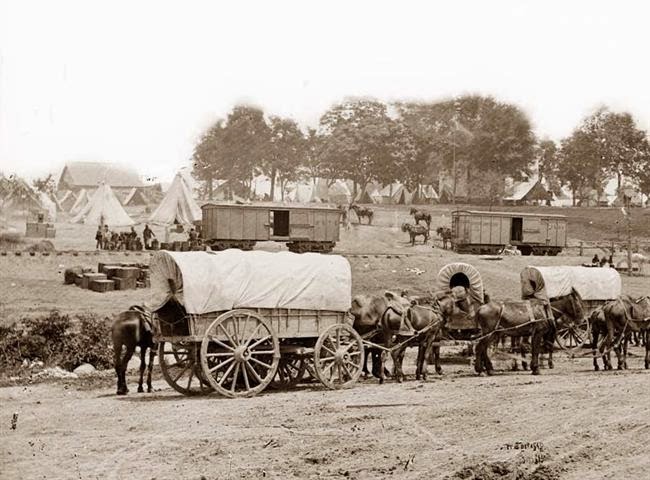

Civil War Supply Wagons
Courtesy of the Library of Congress
First and foremost, it is disappointing that no one has compiled and published her writings.  One of my most profound delights is reading about the experiences and thoughts of a historical figure from their own words.  Barton left literally thousands of documents available so that her life might be remembered and are the basis of cousin William Barton's biography.   She thoughtfully kept her writings and appointed friends and colleagues to a "literary committee" led by William Barton to ensure their availability as reference material.  Accomplishing this feat is now in progress.

Secondly, has Barton been remembered for her most important achievements?  I suspect, for myself, that is the foundation of any new work.  There are times when one, after realizing the effect bias has on Civil War era histories, may have concerns about missing or discarded profoundly helpful lessons overlooked in favor of casting other light.  Should not avoiding repeating past mistakes be history's primary goal?  Or avoiding "reinventing the wheel" while people suffer?  Unfortunately, the US military did reinvent the system of emergency evacuation of wounded during the First World War because the post Civil War draw-down forgot Dr. Jonathan Letterman's groundbreaking work.  Let us remember these important lessons for the future.

Circa 1902 at the Int. Red Cross Conference (age 80!)
Courtesy of commons.wikipedia.org

Remembering Clara Barton is an important step to avoiding some of the pain and trauma that accompanies catastrophic events.  Exploring Barton's life and experiences may inspire many great values and actions such as courage, self-reliance, determination, compassion and tolerance.  As for myself, I know I can use more of those things, it seems unimaginable to have enough of any of them.  Anyone interested in learning more may come to an informal study being held at the Missing Soldiers Office site next Monday, Jan. 13th at 6:30pm.  A few lifetime learners will be discussing Stephen Oates' book A Woman of Valor at that time.

Monday, January 6, 2014

Highlighting Barton's Work

Clara Barton is an American Icon because of some extraordinary achievements made during her lifetime.  They were the result of hard work, but primarily born from determination and perseverence.  We can separate her work into several areas from her overall role as a pioneering American woman, primarily:

Humanitarianism
Educator
International Relief Organizer
Champion of Human Rights

As a Humanitarian, Barton believed in public service and fulfilling the needs of victims of war and natural disasters.  While her focus evolved through the American Civil War, she recognized the needs of other victims while participating in the Franco-Prussian War and reacted to the requests for assistance after man-made and natural disasters.  Once she realized her calling in organizing and delivering aid to those in need, her expansion from military to civilian based work became obvious.  Barton used the expansion to convince the U.S. government that a disaster relief organization was in America's best interests.  Thousands of relief organizations exist due to her international leadership in promoting relief activities.

As an Educator, Barton believed that people could best help themselves through a good education.  She championed education through a long teaching career, and her establishment of the first public school in Bordentown, NJ.  After establishing the American Red Cross, she lobbied within the organization for first aid education.  After its rejection and her resignation from the ARC, she established a non-profit organization, the National First Aid Association of America, to meet the need.  Later absorbed by the ARC, it is a requirement for many public servants and volunteers across the United States today.

As an International Relief Organizer, Barton assisted in saving lives through the support of the military medical system during the American Civil War, the International Red Cross (IRC) during the Franco-Prussian War, and her participation as American diplomat in several Geneva Conventions in the late nineteenth century.  She introduced and lobbied for what became known as the "American Amendment" of the Geneva Convention expanding the IRC's mission to include non-military disasters.  Barton herself traveled to war-torn countries to provide relief to starving and/or homeless refugees, ignoring societal norms of prejudice aimed at minority groups.  She believed that refugees should not be given free aid beyond temporary food and shelter, but given the means to help themselves.  Barton accomplished this in Europe by developing a clothing manufacture through skillless refugee women that ultimately stimulated their economy, taught the refugees a trade, and clothed needy families.

As a Champion of Human Rights, Barton ensured the inclusion of all victims of social injustice when delivering aid to the needy.  She believed in, as she said, "a hand up not a hand out."  During the American Civil War, she often advocated for the fair and equal treatment of the wounded, without regard to creed or race.  During one incident, she went so far as to abandon the field to return to Washington, wake and report the circumstances to her friend and patron, Senator Henry Wilson, and inspire him to immediate action!  On several occasions during the War, she cheerfully worked around established protocol to assist those in dire straits, significantly improving victims chances of survival and quality of life.

Barton also advocated for equal citizenship regardless or race or gender.  She felt that anyone who contributed to society should have a voice in government.  Not only a life-long women's suffragist, she championed suffrage for African-American men and made that a priority, alienating some friends. 

Thursday, December 5, 2013

Christmas in Washington - Civil War Style

Please pardon my recent negligence - the team at the National Museum of Civil War Medicine is working feverishly to build the exhibits for the new Missing Soldiers Office Museum and I recently spoke at the Historical Society of Washington's Historical Studies Conference on a different subject, which garnered a great deal of last minute preparation.  My frenzied activities reminded me of an old saying..."Be careful what you wish for..."!  Nevertheless, back to Miss Barton.

Clara Barton spent several years in Washington during Christmas, which also happened to be her birthday.  My impression from reading diaries and letters is that although she did not dislike the holiday, it wasn't very exciting to her, at least as an adult.  Of course, the Civil War era was quite stressful under the best of circumstances and her committment and frustration working to establishing a national humanitarian relief organization also took a toll on her emotions.  I regret to say that I have not had time to delve deeply into her later years - I've seen some Christmas cards from her that were quite nice in the early twentieth century.  

Description of Washington, December 9, 1861
The streets are thronged with men bright with tinsel, and the clattering hoofs of galloping horses sound continually in our ears.  The weather is bright and warm as May, for which blessing I feel hourly to thank the great Giver of all good gifts, that upon this vast army lying like so many thousand herds of cattle on every side of our bright, beleaguered city, with only the soil, for which they peril life, beneath, and the single threads of white canvas above, watching like so many faithful dogs, held by bonds stronger than death, yet patient and uncomplaining.”
Thomas Nast engraving for Harper's Weekly 1863 - a personal favorite

Letter written December 24, 1861, “…to relate of our big city, grown up so strangely like a gourd all in a night; places which never before dreamed of being honored by an inhabitant save dogs, cats, and rats, are converted into ‘elegantly furnished rooms for rent,’ and people actually live in them with all the city airs of people really living in respectable houses, and I suspect many of them do not know that they are positively living in sheds, but we, who know perfectly we what shelters them.  Well, the present aspect of our capital is a wide fruitful field for description…’

Early Santa by Thomas Nast
Greatly influenced Santa's iconic image in the US

Thursday, November 7, 2013

The High Road's A Hard Road To Travel

Dear Reader,

How is that for a nineteenth century title?  Not long enough?  How do you like The High Road's A Hard Road To Travel, or Courage Can Be A Scary Thing?  One of the idiosyncrasies of nineteenth century literature that amuses me most are those practically paragraphical titles.

Cover of a book on the history of the Washington Artillery of New Orleans
 
I hope this post finds you well.  I have a confession to make.  Regretfully, the other day I failed to take the high road, courage escaped me, or in reality, I rejected it.  While walking to work everyday, I pass two gentlemen who post themselves along the road.  Without fail, one wishes me a great day, the other tips his hat and greets with a smile.  Many folks I know would scoff at these men, one holds a cup out for change, the other is selling his self-published books.  What separates them from others is their offered kindness.  Although their needs are obvious, they do not press them, they offer well-wishes first and foremost.
 
The issue at hand is that I saw the former the other morning and he looked somewhat upset.  He was not at his normal post but may have been in route to it.  He was walking rather quickly, and did not see me as he passed.  It was cold and overcast, I thought I should ask him if he needed some kind of assistance, but I passed and went on to the office.  Later, on the way home, the pangs of guilt began to gnaw at my conscience.
 
One friend I have lives by a newly appointed golden rule:  What Would Clara Do?  It seems quite likely she would have taken a much more elevated path and asked the gentleman if she could relieve his upset.  I suspect she would also likely take me to task for passing on an opportunity to help my fellow man.  She would be right, of course.  It is one of the characteristics of her I admire the most.

The High Road is indeed a very difficult one.  It is inconvenient, sometimes painful, under the most important circumstances frightening and even dangerous.  I watched a segment on the news of a consultant giving advice about how to avoid being killed in a situation like the recent mall attack where terrorists killed random shoppers.  The advice was to run.  Run as fast as you can and get away or hide.  There was no mention of how to get help, help others or best practices in stopping the predators.  Where would society be if everyone took this to heart?  If there was no Clara Barton?

Still going strong at age 75

It seems to me that is why Clara Barton is a legitimate and important character to study, promote and emulate.  Her courage to take the high road should be promoted above her physical features, ability to entertain, physical agility, or even business skills and acumen.  Clara Barton stood up for civil rights, humanity and universal prosperity when others asked what they could do for themselves.  She was selfless, often pushing her physical being to absolute and long-term collapse rather than take the easy road.
 
This post is my penance for taking the easy road.  I hearby resolve to elevate my path to serve others.  I hope this confession may inspire one of my dear readers to do the same.  I challenge you to redeploy random acts of kindness, and remember how sad the world would be without heroes and role models of the likes of one selfless woman, Clara Barton.

Monday, October 28, 2013

Clara Barton and Nursing

Riding into work today, I started thinking (dangerous, I know) about some conversation and my work yesterday in our main office in Frederick, MD.  We were discussing unique merchandising ideas for the Missing Soldiers Office and one particular idea is t-shirts with Barton attributes screen-printed on the front.  We discussed how interesting it might be to see which attribute is most popular with visitors.  Nurse, I think, will be tops because nurses seem to be most enthusiastic as a group towards Barton, but Barton did not want to be remembered for nursing.  That led me to consider what lasting contributions Barton made to the profession. 

Ability.  It seems to me that what Barton contributed most was woman's ability to seriously contribute to the profession.  Most men and women, besides believing it unseemly to care for a strange man, also believed women weren't capable of the mental and physical aptitude required in medical care.  Barton not only showed women were capable in nursing, she also proved women could work as well as men if not better on the extremely stressful conditions of an active battlefield. Working under fire at the Battle of Antietam, her first experience in the heat of battle, she outlasted the assistant surgeons, hospital stewards and many of the surgeons, all the while suffering from symptoms she thought to be typhoid fever.  Her work went well beyond feeding, reading and writing for and other bedside care limiting nurses in long term hospitals.  Barton performed first aid, triage and sometimes transported patients from the field under fire.

Professionalism.  At the beginning of the war, Barton stated that she struggled with the propriety of a woman assisting unrelated men.  She expressed her concerns to her father, on his deathbed, and he advised her that if she acted professionally they would respect her.  Putting her fears aside to fill the great need, Barton found that her father was correct.  She treated her patients with respect and compassion, and they returned the favor.   Barton impressed the most important men - those who could give her access to the battlefield.  From her return from the Battle of Antietam until his tenure of Surgeon General ended, Barton did not have to beg William Hammond for passes to the field, he asked her to go and gave her transportation.  Barton enabled Hammond to circumvent the antiquated military system and get supplies to the field in a more timely manner.  She also respected the chain of command, requesting permission to work from the appropriate authorities, and arguing with beligerent men before going over their head.  Barton garnered cooperation at the appropriate level.  I know of only one exception and it involved timely care.

Barton's work as a nurse, along with several other capable women, led to the eventual establishment of women as nurses after the War.  Unfortunately, society pressed to reestablish former spheres of roles for women and men just after the war ended, but progressive Americans established nursing schools for women, which Barton fully supported.  As a famous humanitarian and civil rights advocate, Barton spoke at several commencement ceremonies urging women to demand acceptance and respect.  According to minoritynurse.com, over 90% of nurses today are women. Barton received many requests for support from what we call today "special interest groups" and she was honest about her priorities and ability to help her favorite causes.  While she turned down active rolls in several, she did make women in the nursing profession a priority.  I believe she would be very proud of how women have taken the challenge and proven her confidence and expectations to be correct.

Thank you to all those who serve as nurses, past and future!

Tuesday, October 15, 2013

The More Things Change...

I went to the Senate accomplished nothing as usual. 
--Clara Barton in her diary, Monday, January 30, 1865

With the Shutdown still bogging down Congress with little hope in sight, I am amused today reading an earlier diary entry from Miss Barton which echoes, I believe today's sentiments regarding our Government in Washington...


Thursday, April 14, 1864

This was one of the most down-spirited days that ever came to me.  All the world appeared selfish and treacherous.  I can get no hold on a good noble sentiment anywhere.  I have scanned over and over the whole moral horizon and it is all dark, the night clouds seem to have shut down, so stagnant, so dead, so selfish, so calculating.  Is there no right?  Are there no consequences attending wrong?  How shall the world move on in all this weight of dead, morbid meanness?  Shall lies prevail forevermore?  Look at the state of things, both civil and military, that curse our Government.  The pompous air with which little dishonest pimps lord it over their betters.  Contractors ruining the Nation, and oppressing the poor, and no one rebukes them.  See a monkey-faced official, not twenty rods from me, oppressing and degrading poor women who come up to his stall to feed their children, that he may steal with better grace and show to the Government how much his economy saves it each month.  Poor blind Government never feels inside his pockets, pouching with ill-gotten gain, heavy with sin.  His whole department know it, but it might not be quite wise for them to speak -- they will tell it freely enough, but will not, dare not affirm it --COWARDS!  Congress knows it, but no one can see that it will make votes for him at home by meddling with it, so it is winked at.  The Cabinet know it, but people that live in glass houses must not throw stones.  So it rests, and the women live lighter and sink lower, God help them.  And next an imbitious dishonest General lays a political plot to be executed with human life.  He is to create a Senator, some memberships, a Governor, commissions, and all the various offices of a state, and the grateful recipients are to repay the favor by gaining for him his confirmation as Major-General.  So the poor rank and file are marched out to do the job, a leader is selected known to be brave and rashness if need be, and given the command in the dark, that he  may never be able to claim any portion of the glory -- so that he cannot say I did it.  Doomed and he knows it, he is sent on, remonstrates, comes back and explains, if left alone with the responsibility on his shoulders, forces divided, animals starving, men suffering, enemy massing in front, and still there he is.  Suddenly he is attacked, defeated as he expected he must be, and the world is shocked by the tales of his rashness and procedure contrary to orders.  He cannot speak; he is a subordinate officer and must remain silent; the thousands with him know it, but they must not speak; Congress does not know it, and refuses to be informed; and the doomed one is condemned and the guilty one asks for his reward, and the admiring world claims it for him.  He has had a battle and only lost two thousand men and gained nothing.  Surely, this deserved something.  And still the world moves on.  No wonder it looks dark, though, to those who do not wear the tinsel.  And so my day has been weary with these thoughts, and my heart heavy and I cannot raise it -- I doubt the justice of almost all I see.

    Evening.  At eight Mr. [Senator Henry] Wilson called.  I asked him if the investigation was closed.  He replied yes, and that General Seymour would leave the Department in disgrace.  This was too much for my fretted soul, and I poured out the vials of my indignation in no stinted measure.  I told him the facts, and what I thought of a Committee that was too imbecile to listen to the truth when it was presented to them; that they had made themselves a laughing-stock for even the privates in the service by their stupendous inactivity and gullibility; that they were all a set of dupes, not to say knaves, for I knew Gray of New York had been on using all his blarney with them that was possible to wipe over them.  When I had freed my mind, and it was some time, he looked amazed and called for a written statement.  He left.  I was anxious to possess myself of the most reliable facts in existence and decide to go to New York and see Colonel Hall and Dr. Marsh again; make my toilet ready, write some letters, and at three o'clock retired.


I can only imagine Senator Wilson's amazement, and I'm even more amazed that he suffered Miss Barton's rants as well as he did and even came back for more. 

Wednesday, October 2, 2013

Fall, 1863

Last year, a college approached me about coming to speak this past spring about Clara Barton's experience at the Battle of Gettysburg.  I felt bad in having to inform the caller that Miss Barton was not at the battle.  She had gone to South Carolina, where her brother David received orders for duty after Senator Henry Wilson applied for a commission to make him a Captain in the quartermaster department, in hopes he could help his sister in the field.  Mr. Barton received the commission, but not an assignment to Miss Barton's favorite army - the Army of the Potomac.  He received orders for the Army of the South, headquartered at Morris Island, SC. 
Capt. David Barton, Clara Barton's older brother
Courtesy of the Clara Barton Birthplace Museum
 
While Miss Barton missed the Gettysburg Campaign, she was present and working for the Siege of Charleston and attack on Fort Wagner made famous in the movie Glory.  After the attack she became very ill and neglected both her diary and letter writing for some time.  Just when I thought I'd begin posting her diary entries I found that none were available.  Before she became ill, however, she did write some letters, a few are quite interesting.  She wrote the following in her diary after a social event,
I moved along to the farther end of the piazza and found Mrs. D., who soon made known to me the subject of her desires.  As I suspected, the matter was hospitals. She has been visiting the hospital at this place and has become not only interested, but excited upon the subject; the clothing department she finds satisfactory, but the storeroom appears empty and a sameness prevailing through food as provided which seems to her appalling for a diet for sick men.  She states that they have no delicacies such as the country at the North are flooding hospitals with; that the food is all badly cooked, served cold, and always the same thing -- dip toast, meat cooked dry, and tea without milk, perhaps once a week a potato for each man, or a baked apple.  She proposed to establish a kitchen department for the serving of proper food to these men, irrespective of the pleasure of the "Powers that Be." She expects opposition from the surgeons in charge and Mrs. Russell, the matron appointed and stationed by Miss Dix, but thinks to commence by littles and work herself in in spite of opposition, or make report direct to Washington through Judge Holt, and other influential friends and obtain a carte blanche from Secretary Stanton to act independetly of all parties.  She wished to know if I thought it would be possible to procure supplies sufficient to carry on such a plan, and people to cook and serve if it were once established and directed properly.  She had just mailed a letter to Miss Dame calling upon her to stir people at the North and make a move if possible in the right direction.  She said General Gillmore took tea with her the evening previous and inquired with much feeling, "How are my poor boys?"  She desired me to attend church at the hospital to-morrow (Sunday) morning; not with her, but go, pass through, and judge for myself.  In the meantime the Major came in and the subject was discussed generally.  I listened attentively, gave it as my opinion that there would be no difficulty in obtaining supplies and means of paying for the preparation of them, but of the manner and feasibility of delivering and distributing them among the patients I said nothing. I had nothing to say.  I partly promised to attend church the next morning, and retired having said very little.  What I have thought is quite another thing.  I have no doubt but the patients lack many luxuries which the country at large endeavors to supply them with, and supposes they have, no doubt; but men suffer and die for the lack of the nursing and provisions of the loved ones at home.  No doubt but the stately, stupendous, and magnificent indolence of the "officers in charge" embitters the days of the poor sufferers who have become mere machines in the hands of the Government to be ruled and oppressed by puffed-up, conceited, and self-sufficient superiors in postion.  No doubt but a good, well-regulated kitchen, presided over with a little good common sense and womanly care, would change the whole aspect of things and lengthen the days of some, and brighten the last days of others of the poor sufferers within the thin wall of this hospital.  I wish it might be, but what can I do?  First it is not my province; I should be out of place there; next, Miss Dix is supreme, and her appointed nurse is matron; next, the surgeons will not brook any interference, and will, in my opinion, resent and resist the smallest effort to break over their won arrangements.  What others may be able to do I am unable to conjecture, but I feel that my guns are effectually silenced.  My sympathy is not destroyed, by any means, but my confidence in my ability to accomplish anything of an alleviating character in this department is completely annihilated.  I went with all I had, to work where I thought I saw greatest need.  A man can have no greater need than to be saved from death, and after six weeks of unremitting toil I was driven from my own tents by the selfish cupidity or stupidity of a pompous staff surgeon with a little accidental temporary authority, and I by the means thrown upon a couch of sickness, from which I barely escaped with my life.  After four weeks of suffering most intense, I rose in my weakness and repaired again to my post, and scarcely were my labors recommenced when, through the same influence or no influence brought to bear upon the General Commanding, I was made the subject of a general order, and commanded to leave the island, giving me three hours in which to pack, remove, and ship four tons of supplies with no assistance that they knew of but one old female negro cook. I complied, but was remanded to Beaufort to labor in the hospitals there. With this portion of the "order" I failed to comply, and went home to Hilton Head and wrote the Commanding General a full explanation of my position, intention, proposed labors, etc., etc., which brought a rather sharp response, calling my humanity to account for not being willing to comply with his specified request, viz. to labor in Beaufort hospitals; insisting upon the plan as gravely as if it had been a possibility to be accomplished. But for the extreme ludicrousness of the thing I should have felt hurt at the bare thought of such a charge against me and from such a quarter. The hospitals were supplied by the Sanitary Commission, Miss Dix holding supremacy over all female attendants by authority from Washington, Mrs. Lander claiming, and endeavoring to enforce the same, and scandalizing through the Press -- each hospital labeled, No Admittance, and its surgeons bristling like procupines at the bare sight of a proposed visitor. How in reason's name was I "to labor there"? Should I prepare my food and thrust it against the outer walls, in the hope it might strengthen the patients inside? Should I tie up my bundle of clothing and creep up and deposit it on the door-step and slink away like a guilty mother, and watch afar off to see if the master of the mansion would accept or reject the "foundling"? If the Commanding General in his wisdom, when he assumed the direction of my affairs, and commanded me where to labor, had opened the doors for me to enter, and the idea would have seemed more practical. It did not occur to me at the moment how I was to effect an entrance to these hospitals, but I have since thought that I might have been expected to watch my opportunity some dark night, and STORM them, although it must be confessed that the popularity of this mode of attack was rather on the decline in this department at that time, having reached its height very soon after the middle of July.

The Storming of Fort Wagner by Allison and Kurz
Courtesy of wikimedia.org
Barton was profoundly disappointed with Gillmore's lack of appreciation and understanding of her work, returning to Washington in January, 1864.  While transcribing this entry from Barton's cousin's biography of the extraordinary American woman, I realized there are many parallels to current events within our government.  Can you see them, too?