I feel compelled to explain my absence. Like Clara sometimes suffered from illness, depression, etc., I have been off taking care of other business for a while. I have also left the National Museum of Civil War Medicine. A new, thoughtful post will be coming soon.
Meanwhile, please keep an eye out for the opening of the Missing Soldiers Office, or take a ride to Glen Echo and visit Clara's old home from Red Cross and later, the Clara Barton National Historic Site. Anyone near Worcester, Massachusetts can visit Clara's birthplace in North Oxford.
Thursday, May 15, 2014

Thursday, March 13, 2014
Connections
One basic rule of business is to
network - make connections - with people that are peers, suppliers, in the
non-profit world, potential funders, and fans to use when necessary to grow. If
a positive personal relationship is developed, one can usually barter for what
they need - a productive symbiotic relationship that benefits everyone. There
is no evidence that Clara Barton ever took a business class or read any
self-help books about building support for her work, but she was born with an
innate ability to network and connect those who could help her that ought to be
the envy of all due to her extraordinary success. This support system is rarely
mentioned, these important people rarely recognized. In fact, I lobbied for
their inclusion as part of the National Museum of Civil War Medicine's upcoming
Missing Soldiers Office (MSO) Museum in Washington, but there is just not
enough space or time to cover all of Barton much less anyone else. To get these
critically important supporters recognized, for their stories are also very
interesting and informative, I will have to do that here on the blog.
The list of supporters is a long
one, her humanitarian career lasted over 50 years. In fact, her support prior
to the war in education and as an independent woman continued to offer help
after her focus changed drastically. Just as the U.S. military could not have
won the Civil War without the significant help it received from civilians,
Clara Barton would be lost to history if not for her friends and fans all over
the U. S. A. I have attempted to list these American patriots in something of
the level of assistance they gave Barton, although it is all arguable. I am
sure to miss quite a few important people since my research has revolved
primarily around the Civil War era, and not the later Red Cross years at this
point. Most family members are not listed due to their obvious support. My list
includes (but is not limited to):
Vice President Henry Wilson - US Senator during the Civil War and Chairman of the
Senate Military Senate Affairs Committee, gave significant emotional and
material support until his death.
 |
| Vice President Henry Wilson |
Nephew Stephen E. Barton -
Gave emotional and material support all through his adult years.
General Daniel H. Rucker - First officer to assist Barton in getting to the
battlefield. In command of the Washington Supply Depots when she first met him,
he would eventually be Quartermaster General of the Army. Barton
transportation, additional supplies and passes to battlefields.
 |
| General Daniel H. Rucker |
 |
| General (Dr.) William A. Hammond |
General William A. Hammond - similar support to Rucker, happy to use Barton to get supplies to the field faster. Sent valuable supplies forward with her for faster delivery.
President Abraham Lincoln - Published a notice naming Barton as head of search for
missing soldiers. She never met him in person, although they were in close
proximity several times.
Secy of War Edwin Stanton - Gave Barton her only official status as a nurse during
the war. When she finally met him in 1865 she was pleasantly surprised to see
him walk towards her with hand extended and a smile after hearing of his
reputation for roughness.
General Benjamin Butler - Got Barton out to the field in 1864, gave her temporary
women's prison reform job after the war.
 |
| General Benjamin Butler |
 |
| Mrs. Frances D. Gage |
Frances D. Gage - Barton called her Aunt Fannie and she gave tremendous emotional support. Mrs. Gage helped Barton establish and create funding opportunities for the Missing Soldiers Office.
Annie Childs - Made most of Barton's clothes at no cost during the war.
Rallied Women's Aid Societies in Massachusetts to send Barton supplies.
Dorence Atwater - supplied Barton with names of over 13,000 soldiers
unreportedly buried at Andersonville Prison, Georgia. Acted as Barton's escort
and co-speaker during her initial lecture circuit.
 |
| Dorence Atwater |
Jules Golay - worked at MSO and provided place for Barton to stay in
Europe.
General John J. Elwell - Provided emotional support during Barton's stay in South
Carolina. Quartered in a room down the hall, Elwell escorted Barton on many
horseback rides, picnics, and dining.
 |
| General John J. Elwell |
 |
| Edward Shaw, Esquire |
Edward Shaw - Sublet Barton her rooms on 7th Street during the War. Helped her work at the MSO.
General U.S. Grant - gave Barton and one companion free transportation to
assist with MSO and endorsed her work.
Honorable Alexander DeWitt - introduced Barton to Massachusetts society in Washington
and helped her get work at the Patent Office.
 |
| Honorable Alexander DeWitt |
 |
| Dr. Jullian Hubbell |
Dr. Jullian Hubbell - led field work for Barton during the Red Cross years. Barton's trust of Hubbell cut back on how many disasters she felt compelled to attend to personally. For his loyalty and friendship, Barton left him the Glen Echo home in her will.
General Ethan Allen Hitchcock - endorsed Barton's work, writing her introduction to the
Provost Marshall in Annapolis and concurring with Generals Rucker and Grant,
and (approved by) President Johnson regarding government printing of the Rolls
of Missing Men.
I hope you enjoyed meeting some of
Clara Barton's best friends and supporters. Wait! That can not be all?! Can you
think of anyone else? Leave a comment with a name of the friend and brief
description. Thank you for your contribution in advance!
 |
| General Ethan Allan Hitchcock |
Wednesday, February 19, 2014
Bully For Clara?
Recently it is reported in the news that workplace bullying is a reality, viz. a report that found that a former lineman for a professional football team was bullied by coworkers with the full support of the coaching staff. The man accused of bullying the lineman claims that what happened was not bullying but a method of toughening up a player to make them more aggressive. The investigator wrote that besides racial and sexual slurs aimed particularly at the player, his family was also threatened. That seems to be a peculiar way of toughening one up. It is sad to see that bullying is not just taking place in schools, but in the workplace as well.
One may wonder, what does this have to do with Clara Barton? She was famously bullied while working at the Patent Office in the 1850s. She was the first woman to receive a permanent position at the same rate of pay as her male coworkers. Most biographers cover the period without telling the whole story. They wrote that the men were jealous of Barton's position and her pay since women were considered second class citizens unable to perform the tasks given men.
As Paul Harvey used to say, "and now, the rest of the story." In an interview with Lenora Halstead in 1890, Miss Barton gives some details of her work that shed a good deal of light about how her co-workers treated her. She told Ms. Halstead,
 |
| Workplacing bullying at its worst! |
One may wonder, what does this have to do with Clara Barton? She was famously bullied while working at the Patent Office in the 1850s. She was the first woman to receive a permanent position at the same rate of pay as her male coworkers. Most biographers cover the period without telling the whole story. They wrote that the men were jealous of Barton's position and her pay since women were considered second class citizens unable to perform the tasks given men.
As Paul Harvey used to say, "and now, the rest of the story." In an interview with Lenora Halstead in 1890, Miss Barton gives some details of her work that shed a good deal of light about how her co-workers treated her. She told Ms. Halstead,
The carriage of the Comm[issioner] of Patents called with the request that I sh[oul]d get in & drive down to see him. It was a most unusual thing for a woman to go to one of the Dep[ar]t[ment]s; in those days there was not a woman on their payrolls not one. There were a few women, the d[aughte]rs and widow of a man who had died who did his work & rec’d pay in his name, but this was substitution and was almost unknown. However, I got into the carriage & went to see the Comm. as requested. In his room the first person I saw was an old friend of my father’s who had known me from childhood and who welcomed me cordially. The Comm. asked me, he said after he had presented me, if I know of a man of perfect integrity & trustworthiness, whoed [sic] do some important work for him in finding out where frauds had been perpetrated in his accounts, and I told him I knew of no such man, but I did know a woman who c[oul]d exactly serve him and he told me to send for her, & so here you are. I tried to disclaim his praises but the Comm w[oul]d not listen to me & only asked me if I w[oul]d take the place? I said, ‘Why, I don’t know why I sh[oul]dn’t, yes, I will.” “Very well,” said he, “I am delighted to hear it now when you can come?” “There you choose, said I. “Can you stay now?” “Certainly, “ and I took off my bonnet & shawl & staid [sic]. I worked in that office from that time; I found the frauds, & my service was the first woman’s name to go on the payrolls. It made a great commotion. The clerks; they knew what it meant, & they tried to make the place too hard for me. It wasn’t a pleasant experience, in fact, it was very trying, but I thought perhaps there was some question of principle involved & I lived it through. (italics mine)
Now there's the rub-- Barton stated that she was brought into the Office to investigate fraud and she found some, certainly leading to the dismissal of clerks and examiners. The Commissioner, Judge Charles Mason, became famous as the man who reformed the Patent Office. Evidently, Barton conducted the investigation. It seems reasonable that these clerks were not only jealous of Barton's unusual position, but she also posed a direct threat to their employment. That threat would certainly cause some men to react by making Barton's life miserable. Perhaps Barton was not the sweet innocent victim of abuse that writers have made her out to be. It does not excuse the abuse, but it does give a clearer understanding of the situation at the time. Barton had every right to feel justified in her work exposing illegal activities in the Office, but leaving that tidbit of information out implies Barton did nothing to cause the abuse.

Iowa Supreme Court Justice Charles Mason
I have to admit, it may well be that this story lost credibility with interpreters because of the lateness of the interview. Barton was 68 years old in March of 1890. Any well-trained historian knows that the farther away from an event the less accurate it will be. But then, family and friends remarked on Barton's keen mind up until her death at age 90.
Unfortunately, there was nothing Barton could do about the bullies, but it is a shame Mason did not do anything to stop it, or some other man at the Patent Office. Evidently, according to the Workplace Bullying Institute, that is not unusual and sometimes, as in the case in football, it appears even conducted or sanctioned by leadership. The institute points out that workplace bullying actually reduces the productivity and revenue for an organization that does nothing to stop it. One would think that from a purely business perspective that would be incentive enough for businesses to be pro-active in preventing bullying. Although no one should have to endure the abuse Barton did, I admire her for her determination to ignore the abuse and continue her work. She could be one tough lady.
For more information about today's problems with workplace bullying, go to http://www.workplacebullying.org.
Unfortunately, there was nothing Barton could do about the bullies, but it is a shame Mason did not do anything to stop it, or some other man at the Patent Office. Evidently, according to the Workplace Bullying Institute, that is not unusual and sometimes, as in the case in football, it appears even conducted or sanctioned by leadership. The institute points out that workplace bullying actually reduces the productivity and revenue for an organization that does nothing to stop it. One would think that from a purely business perspective that would be incentive enough for businesses to be pro-active in preventing bullying. Although no one should have to endure the abuse Barton did, I admire her for her determination to ignore the abuse and continue her work. She could be one tough lady.
For more information about today's problems with workplace bullying, go to http://www.workplacebullying.org.
Friday, February 7, 2014
A Little Miscommunication: Three Cheers for Clara Barton!
In 1882, a veteran's reunion group asked Clara Barton to come speak at an event. At this time strong lobbying efforts for women's rights by Susan B. Anthony and her followers obviously annoyed some men. According to Barton, the group reassured their membership stating,
As I read this, I thought about the silence before a young child screams after being hurt, pictured the steam escaping adult human ears when furious- as forceful and noisy as a steam engine's boiler being reduced, pictured the veins popping and red neck that Gen. Robert E. Lee's staff allege he displayed when highly annoyed...oh boy, this is going to hit the roof! I was not disappointed.
Her response:
I believe that cleared any misunderstandings up quite well as well as establish "what class of woman" Clara Barton was, don't you?
We can promise our citizens a rare treat of patriotic eloquence such as is seldom listened to X X and we can assure them that there will be no cause for disappointment, they will not have thrust upon them a lecture on woman's rights after the style of Susan B. Anthony and her clique. Miss Barton does not belong to that class of women.
As I read this, I thought about the silence before a young child screams after being hurt, pictured the steam escaping adult human ears when furious- as forceful and noisy as a steam engine's boiler being reduced, pictured the veins popping and red neck that Gen. Robert E. Lee's staff allege he displayed when highly annoyed...oh boy, this is going to hit the roof! I was not disappointed.
Her response:
My blood boiled as I read and faced an audience of which the most exacting speaker might be proud, not even standing room in the aisles. And I treated them to their feast of 'Patriotic eloquence' a vim I had no power to control. I could feel the indignation hiss between my teeth as the words rolled almost unbidden, but I held firmly to my subject till it was ended, and when they had shouted and cheered to a tiger I resumed- in the following text--
'Soldiers, you have called me here to speak to you on the war we lived together. I have done it. Now I have a word for you. I wish to read this paragraph which you have used to help fill your hall,-' I read it very slowly and distinctly.
That paragraph, my comrades, does worse than misrepresent me as a woman, it maligns my friend and it allures the brightest and bravest work ever done in the land for either me or you. You glorify the women who made their way to the front to seek you out in your misery and nurse you back to life. You call us angels. Who opened the war for us to go, and made it possible, who but that detested set of women who for years had claimed that women had rights and should have the privilege to exercise them, the right to her own property, her own children, her own home, to her freedom of action, to her personal liberty, and upon this other women have claimed the right and took the courage if only to go to a camp and drag a wounded man out of a swamp [?] and try to save him for his family and country.
And soldiers, for every woman's hand that ever cooled your fevered brow, staunched your bleeding wounds or called life back to your famished body you should bless God for Susan B. Anthony, Cady Stanton and their followers. No one has stood so alone, so unhelped as Susan Anthony and Soldiers I would have the first monument that is ever raised to any woman in this country raised to her, and that monument will be raised and your daughters, boys will help proudly, gratefully help to set its granite blocks for everlasting age, set it where all may see. And I would reproduce the eloquence of Webster at Bunker Hill-, [']Let the earliest light of the morning gild it and parting long linger and play on its summit.[']
Boy's, three cheers for Susan Anthony!
And the very windows shook in their easements.
I believe that cleared any misunderstandings up quite well as well as establish "what class of woman" Clara Barton was, don't you?
Wednesday, January 22, 2014
Barton Hall of Fame Nominee Lucy Stone
While considering how to convey the suspected reasoning behind Clara Barton's nomination of Lucy Stone Blackwell, the best short phrase that keeps coming to mind is "The Original American Women's Libber.” During my vetting process, one article on Stone-Blackwell states, "Stone was known for using her maiden name after marriage." Unlike some of the other women ahead of their time in the 19th century, the choice did not seem to affect her marriage.
 |
| Lucy Stone Courtesy of |
Lucy Stone, like Barton, hailed from Central Massachusetts. Working through genealogical records found no biological kinship between Barton and Stone even though only a mere 19 miles separate their hometowns. Stone also, like Barton, grew up believing she could accomplish almost anything a man could and never understood why anyone considered women inferior to men. While Barton would go on to a career in humanitarianism, Stone would promote women's suffrage.
Barton and Stone also shared the teaching profession early in their adulthood that impacted their ideas about women's rights. For Barton, teaching was somewhat a family occupation; both her sisters taught and her older brother Stephen superintended the Oxford, Massachusetts school system for a time. Stone also followed in her older siblings footsteps, and left the profession when paid less than her brother for substituting for him. Barton left when the public school committee in Bordentown, NJ hired a man as principal at the school she had organized and established. Neither would go back to the classroom as a teacher.
Stone received her baccalaureate degree from Oberlin Collegiate Institute in Ohio on August 25, 1847, becoming the first female college graduate from Massachusetts. Influenced by abolitionist and women's suffrage lecturers such William Lloyd Garrison, Sarah Grimke, and Antoinette Brown, Stone decided on a career as a public speaker. Surprisingly, the men in her family supported the idea, while Stone's mother and sisters did not. Stone began giving anti-slavery lectures in Massachusetts, but by 1849 also spoke in New York and Pennsylvania. National recognition came by 1851.
 |
| Henry Blackwell Courtesy of |
Unlike Barton, Stone married Henry Blackwell after a two-year courtship. Blackwell became Stone's manager and took the unusual step of a prenuptial agreement stating the couple were partners, would share costs of maintaining a household equally, and allowing Stone to keep her last name. Blackwell went so far as to include a protest of man's superiority over his wife and vowed not to do so. The Worcester (Massachusetts) Spy published the protest and made national headlines. Stone would bear one daughter, Alice, born in 1857, who went on to follow in her mother's footsteps.
 |
| Lucy and daughter Alice Courtesy of |
 |
| Lucy in later years Courtesy of |
Thursday, January 9, 2014
To Write Or Not To Write...
It seems most would agree that to make a reputation as an influential professional historian, one must write and publish not only books, but all sorts of printed matter for public consumption. Yesterday, at the main museum I noticed a new book in our library, Lincoln and Whitman, by William E. Barton, Clara Barton's cousin. Funny I thought, I was just looking through his biography of Miss Barton to find some outstanding quotes for part of the CBMSO's exhibits, and spoke to the museum's Director of Research about his peerless credibility as a Barton biographer. The inside cover of Lincoln and Whitman is filled with several reviews by his peers outlining his expertise as a Lincoln scholar.
Part of my work at the museum is to develop material for all types of programming. Naturally, my first thoughts centered on what to write and publish in regards to my research on Barton. But a problem arises due to the amount of work already available to the public. One may find so much varying material on Barton already that covers just about every aspect of her being as to give a fairly balanced perception of this legendary woman. William Barton's biography and Stephen Oates' focus on the Civil War years (A Woman of Valor: Clara Barton and the Civil War), two favorites, leave almost no stone unturned. While writing and designing programming material is still necessary to cover specific aspects the museum will highlight, the question still remains- what major work could be accomplished on Barton that will fascinate and inspire interested citizens as well as catch those who are blissfully unaware of the extraordinary importance of a long-gone heroine?
First and foremost, it is disappointing that no one has compiled and published her writings. One of my most profound delights is reading about the experiences and thoughts of a historical figure from their own words. Barton left literally thousands of documents available so that her life might be remembered and are the basis of cousin William Barton's biography. She thoughtfully kept her writings and appointed friends and colleagues to a "literary committee" led by William Barton to ensure their availability as reference material. Accomplishing this feat is now in progress.
Secondly, has Barton been remembered for her most important achievements? I suspect, for myself, that is the foundation of any new work. There are times when one, after realizing the effect bias has on Civil War era histories, may have concerns about missing or discarded profoundly helpful lessons overlooked in favor of casting other light. Should not avoiding repeating past mistakes be history's primary goal? Or avoiding "reinventing the wheel" while people suffer? Unfortunately, the US military did reinvent the system of emergency evacuation of wounded during the First World War because the post Civil War draw-down forgot Dr. Jonathan Letterman's groundbreaking work. Let us remember these important lessons for the future.

Remembering Clara Barton is an important step to avoiding some of the pain and trauma that accompanies catastrophic events. Exploring Barton's life and experiences may inspire many great values and actions such as courage, self-reliance, determination, compassion and tolerance. As for myself, I know I can use more of those things, it seems unimaginable to have enough of any of them. Anyone interested in learning more may come to an informal study being held at the Missing Soldiers Office site next Monday, Jan. 13th at 6:30pm. A few lifetime learners will be discussing Stephen Oates' book A Woman of Valor at that time.
Part of my work at the museum is to develop material for all types of programming. Naturally, my first thoughts centered on what to write and publish in regards to my research on Barton. But a problem arises due to the amount of work already available to the public. One may find so much varying material on Barton already that covers just about every aspect of her being as to give a fairly balanced perception of this legendary woman. William Barton's biography and Stephen Oates' focus on the Civil War years (A Woman of Valor: Clara Barton and the Civil War), two favorites, leave almost no stone unturned. While writing and designing programming material is still necessary to cover specific aspects the museum will highlight, the question still remains- what major work could be accomplished on Barton that will fascinate and inspire interested citizens as well as catch those who are blissfully unaware of the extraordinary importance of a long-gone heroine?
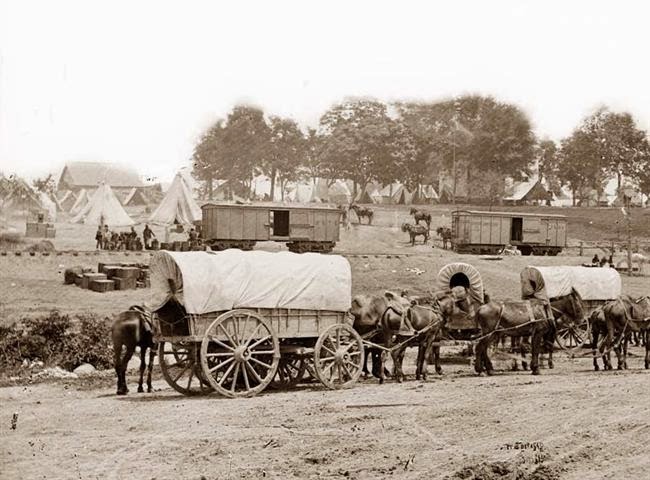 |
| Civil War Supply Wagons Courtesy of the Library of Congress |
Secondly, has Barton been remembered for her most important achievements? I suspect, for myself, that is the foundation of any new work. There are times when one, after realizing the effect bias has on Civil War era histories, may have concerns about missing or discarded profoundly helpful lessons overlooked in favor of casting other light. Should not avoiding repeating past mistakes be history's primary goal? Or avoiding "reinventing the wheel" while people suffer? Unfortunately, the US military did reinvent the system of emergency evacuation of wounded during the First World War because the post Civil War draw-down forgot Dr. Jonathan Letterman's groundbreaking work. Let us remember these important lessons for the future.
Circa 1902 at the Int. Red Cross Conference (age 80!)
Courtesy of commons.wikipedia.org
Remembering Clara Barton is an important step to avoiding some of the pain and trauma that accompanies catastrophic events. Exploring Barton's life and experiences may inspire many great values and actions such as courage, self-reliance, determination, compassion and tolerance. As for myself, I know I can use more of those things, it seems unimaginable to have enough of any of them. Anyone interested in learning more may come to an informal study being held at the Missing Soldiers Office site next Monday, Jan. 13th at 6:30pm. A few lifetime learners will be discussing Stephen Oates' book A Woman of Valor at that time.
Monday, January 6, 2014
Highlighting Barton's Work
Clara Barton is an American Icon because of some extraordinary achievements made during her lifetime. They were the result of hard work, but primarily born from determination and perseverence. We can separate her work into several areas from her overall role as a pioneering American woman, primarily:
Humanitarianism
Educator
International Relief Organizer
Champion of Human Rights
As a Humanitarian, Barton believed in public service and fulfilling the needs of victims of war and natural disasters. While her focus evolved through the American Civil War, she recognized the needs of other victims while participating in the Franco-Prussian War and reacted to the requests for assistance after man-made and natural disasters. Once she realized her calling in organizing and delivering aid to those in need, her expansion from military to civilian based work became obvious. Barton used the expansion to convince the U.S. government that a disaster relief organization was in America's best interests. Thousands of relief organizations exist due to her international leadership in promoting relief activities.
As an Educator, Barton believed that people could best help themselves through a good education. She championed education through a long teaching career, and her establishment of the first public school in Bordentown, NJ. After establishing the American Red Cross, she lobbied within the organization for first aid education. After its rejection and her resignation from the ARC, she established a non-profit organization, the National First Aid Association of America, to meet the need. Later absorbed by the ARC, it is a requirement for many public servants and volunteers across the United States today.
As an International Relief Organizer, Barton assisted in saving lives through the support of the military medical system during the American Civil War, the International Red Cross (IRC) during the Franco-Prussian War, and her participation as American diplomat in several Geneva Conventions in the late nineteenth century. She introduced and lobbied for what became known as the "American Amendment" of the Geneva Convention expanding the IRC's mission to include non-military disasters. Barton herself traveled to war-torn countries to provide relief to starving and/or homeless refugees, ignoring societal norms of prejudice aimed at minority groups. She believed that refugees should not be given free aid beyond temporary food and shelter, but given the means to help themselves. Barton accomplished this in Europe by developing a clothing manufacture through skillless refugee women that ultimately stimulated their economy, taught the refugees a trade, and clothed needy families.
As a Champion of Human Rights, Barton ensured the inclusion of all victims of social injustice when delivering aid to the needy. She believed in, as she said, "a hand up not a hand out." During the American Civil War, she often advocated for the fair and equal treatment of the wounded, without regard to creed or race. During one incident, she went so far as to abandon the field to return to Washington, wake and report the circumstances to her friend and patron, Senator Henry Wilson, and inspire him to immediate action! On several occasions during the War, she cheerfully worked around established protocol to assist those in dire straits, significantly improving victims chances of survival and quality of life.
Barton also advocated for equal citizenship regardless or race or gender. She felt that anyone who contributed to society should have a voice in government. Not only a life-long women's suffragist, she championed suffrage for African-American men and made that a priority, alienating some friends.
Humanitarianism
Educator
International Relief Organizer
Champion of Human Rights
As a Humanitarian, Barton believed in public service and fulfilling the needs of victims of war and natural disasters. While her focus evolved through the American Civil War, she recognized the needs of other victims while participating in the Franco-Prussian War and reacted to the requests for assistance after man-made and natural disasters. Once she realized her calling in organizing and delivering aid to those in need, her expansion from military to civilian based work became obvious. Barton used the expansion to convince the U.S. government that a disaster relief organization was in America's best interests. Thousands of relief organizations exist due to her international leadership in promoting relief activities.
As an Educator, Barton believed that people could best help themselves through a good education. She championed education through a long teaching career, and her establishment of the first public school in Bordentown, NJ. After establishing the American Red Cross, she lobbied within the organization for first aid education. After its rejection and her resignation from the ARC, she established a non-profit organization, the National First Aid Association of America, to meet the need. Later absorbed by the ARC, it is a requirement for many public servants and volunteers across the United States today.
As an International Relief Organizer, Barton assisted in saving lives through the support of the military medical system during the American Civil War, the International Red Cross (IRC) during the Franco-Prussian War, and her participation as American diplomat in several Geneva Conventions in the late nineteenth century. She introduced and lobbied for what became known as the "American Amendment" of the Geneva Convention expanding the IRC's mission to include non-military disasters. Barton herself traveled to war-torn countries to provide relief to starving and/or homeless refugees, ignoring societal norms of prejudice aimed at minority groups. She believed that refugees should not be given free aid beyond temporary food and shelter, but given the means to help themselves. Barton accomplished this in Europe by developing a clothing manufacture through skillless refugee women that ultimately stimulated their economy, taught the refugees a trade, and clothed needy families.
As a Champion of Human Rights, Barton ensured the inclusion of all victims of social injustice when delivering aid to the needy. She believed in, as she said, "a hand up not a hand out." During the American Civil War, she often advocated for the fair and equal treatment of the wounded, without regard to creed or race. During one incident, she went so far as to abandon the field to return to Washington, wake and report the circumstances to her friend and patron, Senator Henry Wilson, and inspire him to immediate action! On several occasions during the War, she cheerfully worked around established protocol to assist those in dire straits, significantly improving victims chances of survival and quality of life.
Barton also advocated for equal citizenship regardless or race or gender. She felt that anyone who contributed to society should have a voice in government. Not only a life-long women's suffragist, she championed suffrage for African-American men and made that a priority, alienating some friends.
Subscribe to:
Posts (Atom)